At Nobility Wireless, we talk to small business owners every week who are trying to figure out which phones to buy for their team — and almost all of them are asking the wrong question.
What’s the best cell phone for small business in 2026 — and how do you buy several of them without getting burned on price, compatibility, or support lifecycles?
I’ve spent 20 years in the secondary mobile market. I’ve watched IT managers overpay retail for devices that were EOL’d 18 months later, and I’ve watched small business owners hand out mismatched phones that their MDM couldn’t manage consistently. The mistakes are almost always the same.
What Makes the Best Cell Phones for Small Business?
Consumer “best phone” lists chase cameras and benchmarks. Small businesses care about different things. When you’re equipping a small team, weigh these five factors first:
1. Security support window
This is the single most important spec, and the one buyers overlook most. A cheap phone that stops getting security patches in two years is a liability, not a saving. Federal guidance agrees: CISA’s mobile security best practices explicitly recommend choosing devices from manufacturers with long-term update commitments. Google and Samsung now offer up to seven years of updates on the right models; Apple typically supports iPhones for six to seven years in practice. Buy for the support window, not just the sticker price — and pair the hardware with a basic plan like the one in the FCC’s small-business cybersecurity guide.
2. Total cost, not unit price
A $200 phone that lasts three years costs more per working year than a $450 phone supported for seven. Think in cost-per-supported-year across the fleet, especially once you’re buying more than a handful.
3. Ease of buying several at once
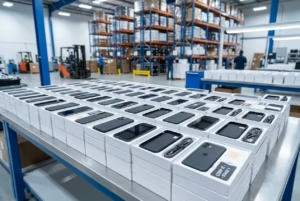
Ordering phones one at a time from a carrier is slow and inconsistent. Buying unlocked devices in bulk from one supplier keeps your team on the same models, simplifies replacements, and avoids carrier lock-in. Our business smartphones in bulk page covers how that works.
4. Consistency across the team
Standardizing on one or two models makes support, training, and accessories far easier. It also means a lost or broken phone is a same-day swap, not a project.
5. Fit with your existing tools
If your team lives in Google Workspace, Pixel and Galaxy devices feel native. If you’re an Apple shop, the iPhone slots straight into iCloud and Apple Business Manager.
Our Top Small Business Phone Picks (2–50 Employees)
Here are five of the best cell phones for small business right now, spread across budget, mid-range, and premium tiers. Security-support dates are manufacturer commitments as of early 2026.
| Phone | Price tier | Battery | Storage | Security support through | Best for |
|---|---|---|---|---|---|
| Samsung Galaxy A16 | Budget | ~5,000 mAh | 128 GB (microSD) | ~Oct 2030 (6 yrs) | Lowest cost-per-device on larger rollouts |
| Samsung Galaxy A17 5G | Lower-mid | ~5,000 mAh | 128 GB | ~2031 (6 yrs) | Balanced value for a mixed team |
| Google Pixel 9 | Mid-range | ~4,700 mAh | 128 / 256 GB | ~2032 (7 yrs) | Best longevity-per-dollar; Google Workspace teams |
| Apple iPhone 16 | Premium value | ~3,582 mAh | 128 / 256 / 512 GB | ~2032+ (Apple, ~6–7 yrs) | Apple-standardized teams; easy ABM enrollment |
| Samsung Galaxy S24 | Premium | ~4,000 mAh | 128 / 256 GB | ~2031 (7 yrs) | Flagship Android with the longest Samsung support |
Any of these will serve a small team well for years. Explore current Samsung wholesale and Apple wholesale options to see what’s in stock and at what volume.
iPhone vs Android for a Small Team
There’s no universally “best” answer — the right platform is the one your team and tools already lean toward. Pick iPhone if your staff already use Macs and iCloud, you want the simplest device enrollment through Apple Business Manager, and you value a long, predictable resale life. Pick Android (Pixel or Galaxy) if you run Google Workspace, want more choice across price tiers, or need the longest guaranteed security support for the money.
For most small businesses, the deciding factor is consistency: whichever platform you choose, standardize on it. A team split between iPhones and Androids doubles your support surface for no real benefit.
New vs Certified Like-New: What Small Businesses Should Buy
Buying brand-new isn’t always the smart move for a small business. Certified Like-New (professionally inspected and restored) devices can cut per-unit cost by a large margin while still shipping unlocked, tested, and warrantied. The key is buying from a supplier that inspects every device rather than reselling untested stock.
A practical approach for a small team: put customer-facing or heavy-use staff on newer devices, and equip lighter users with Certified Like-New units of the same model line. You keep the fleet consistent and stretch the budget at the same time.
How Long Will These Phones Stay Secure?
Security support is what separates a genuine business phone from a disposable one. As of early 2026, the standouts are the Pixel 9a (about seven years, into 2032) and the Galaxy S24 (seven years, through 2031). Even the budget Galaxy A16 5G is committed to roughly six years of updates, into late 2030 — remarkable for its price. You can confirm any Samsung model’s current patch status on Samsung’s security update page. Apple doesn’t publish a fixed number, but iPhones like the 16e have historically received six to seven years of iOS updates.
The takeaway: on a modern mid-range or flagship phone, security support is no longer the thing that ends a device’s useful life. Battery health and physical wear usually come first — which is another reason a consistent, easily replaceable fleet matters.
How Many Phones Before You Get Bulk Pricing?
Bulk pricing generally kicks in earlier than most small business owners expect — you don’t need to be a large enterprise. The bigger wins from buying in volume aren’t only per-unit discounts; they’re consistency (everyone on the same model), reliable lead times, and a single point of contact for replacements. If you’re outfitting even a modest team, it’s worth getting a wholesale quote rather than buying at retail one phone at a time.
Matching Phones to How Your Team Works
Finally, map the device to the job. Field and warehouse staff benefit from the big batteries and rugged simplicity of the Galaxy A-series. Office and client-facing staff are well served by the Pixel 9a or iPhone 16e. Leadership or power users who keep a phone longest are the best fit for a flagship like the Galaxy S24. Buying for the role — not one phone for everyone — is often where a small business gets the most from its budget.
We also carry an extensive line of wholesale tablets from all manufactureres.
Ready to line up the options? Compare business phones with our decision tool, then request a wholesale quote on the models that fit.