
When do smartphone supply chain delays actually become your problem? Not when they make the news. When your carrier rep tells you the models you spec'd are backordered six to eight weeks — and your deployment window is three weeks out. That's when it lands.
I've watched this play out across every major market disruption of the last decade. The organizations that got hurt worst were the ones treating the carrier channel as their only sourcing option. The ones that came through it — on time, on budget — had a secondary source already in place.
Why the Supply Chain Is Still Fragile
The consumer narrative is usually "shortages are over." But enterprise procurement runs on longer cycles than retail, and the underlying vulnerabilities haven't gone away.
Semiconductor production is still concentrated in a handful of fabs in Taiwan and South Korea. A geopolitical event, a weather disruption, a yield problem — any of that translates into allocation squeezes downstream. Apple and Samsung have more negotiating leverage than your carrier. Your carrier has more than your reseller. By the time the shortage signal reaches you, the inventory's already gone.
Shipping lane disruptions compound this. The Red Sea rerouting that began in late 2023 added weeks to transit times for devices shipping out of Asian manufacturing hubs. That delay doesn't just affect a single shipment — it cascades into the allocation cycle. Carriers and OEMs prioritize consumer launches and tier-1 retail partners first. Enterprise and government buyers absorb the shortfall. UNCTAD's trade disruption data has been tracking the downstream effect on manufactured goods, and mobile devices aren't immune.
Tariffs add another layer. Every time import duty structures shift — and they've shifted significantly in recent years — OEMs and distributors adjust inventory positioning and pricing. Some models get deprioritized for certain markets. Some SKUs quietly disappear. You don't always get advance notice. Guidance from the Bureau of Industry and Security on export controls and trade restrictions gives you a sense of how many regulatory levers can affect device availability at any point.
What Procurement Delays Actually Cost
The direct cost is easy to see: you pay more when inventory is tight. But the indirect costs are worse.
Delayed deployments mean employees running on failing hardware longer — productivity loss, IT support overhead, and in regulated industries, potential compliance exposure when device management policies can't be enforced on out-of-support hardware. For wholesale phones for logistics fleets, this is especially acute. ELD compliance depends on functional, enrolled devices. A six-week backorder isn't a minor inconvenience when your drivers need compliant hardware to operate legally.
Rush procurement is expensive. When you're up against a deadline and the standard channel is dry, you end up paying retail or near-retail for spot inventory. A 20–40% premium doesn't show up in any delay analysis, but it's real money. And if your annual device budget assumed MSRP-adjacent carrier pricing, a supply crunch forces you to either absorb the overage, cut deployment scope, or go back to finance. None of those are good options.
The Secondary Market as a Sourcing Hedge
Here's where I want to push back on an assumption a lot of enterprise IT teams carry: that buying outside the OEM/carrier channel means taking on risk.
It depends entirely on where you're buying. The secondary mobile market covers a wide range — peer-to-peer resale, gray market imports, certified wholesale distribution. Those aren't the same thing, and the risk profile is completely different. Knowing how to choose a wholesale phone supplier is what separates a smart hedge from a liability.
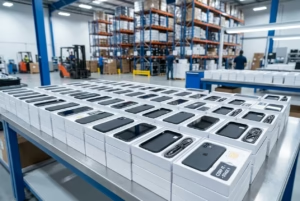
What Nobility Wireless distributes is factory-sealed, unopened, unactivated devices. Not refurbished, not repaired, not previously enrolled. Inventory that moves through the secondary market because of trade-in programs, carrier overstock, and upgrade cycles — not because something went wrong with the device. Every unit goes through a 35-point PhoneCheck certification before it ships.
The result is a return rate under 1%. That number holds across customers deploying 10 devices and customers deploying 10,000+. For context, new device return rates through carrier channels typically run around 5%. The "safe" channel isn't always safer.
Carrier-Agnostic Inventory Changes the Equation
One of the hidden costs of carrier-dependent procurement is that you're locked into their SKU availability. If your carrier is out of a specific model, you're waiting — or switching models mid-deployment, which creates MDM headaches.
Factory-unlocked, carrier-agnostic inventory solves that. Our catalog runs 100+ devices across Samsung, Apple, Google Pixel, Motorola, and more. Every device ships ready for MDM enrollment — Knox, zero-touch, Apple ABM — so there's no configuration lag when a model substitution is necessary. You pick the device that fits your fleet, not the one your carrier happens to have in stock.
For teams managing bulk phone procurement at scale, that flexibility is the difference between a deployment that hits its window and one that doesn't.
Rethinking the Procurement Model
The organizations that handle supply chain volatility best aren't necessarily the ones with the biggest budgets or the best carrier relationships. They're the ones that treat device procurement like any other strategic sourcing category: with multiple channels, pre-qualified backup suppliers, and a clear-eyed view of where their single points of failure are.
If your current setup is carrier-only, you have one. And the next disruption — whatever its cause — will find it.
There's also a financial argument that's worth making explicitly. Secondary market wholesale pricing runs 20–40% below MSRP. On a 500-device refresh, that's $50,000–$200,000 in savings depending on the models — and that's on bulk wholesale devices even in a normal supply environment. In a constrained one, the secondary market may be the only place the inventory exists at all.
If you're thinking through how this fits your procurement workflow, it's worth reading up on transactional sourcing for mobile devices — the operational mechanics of pulling from the secondary market alongside your primary channel without creating enrollment or inventory tracking conflicts.
What to Look for in a Wholesale Device Source
Not all secondary market distributors are the same. A few things that actually matter when you're evaluating one as a procurement hedge:
Inspection and certification. A distributor that doesn't run devices through third-party diagnostic testing before shipping isn't a distributor — they're a middleman moving boxes. PhoneCheck certification on every unit gives you an audit trail and a meaningful quality guarantee, not just a verbal assurance.
MDM readiness. If a supplier can't confirm that devices are factory-unlocked and enrollment-ready before they ship, that's a problem. Knox enrollment, zero-touch, and Apple ABM compatibility aren't optional for enterprise buyers — they're how you deploy at scale without your IT team manually configuring every device.
Catalog depth. A supplier that carries three models isn't a hedge. You need access to enough SKUs that if one model has a supply problem at the OEM level, there's a real substitute available without compromising your deployment specs.
Return rate transparency. Ask for it. Any distributor worth working with should be able to tell you what their actual return rate is, not just describe their QC process. Under 1% is the bar we hold ourselves to. It's achievable, but not everyone meets it.
Smartphone supply chain delays aren't going away. The underlying conditions — geographic concentration of manufacturing, geopolitical friction, tariff volatility — are structural, not cyclical. The right response isn't to wait for the channel to stabilize. It's to build a procurement approach that doesn't depend on it staying stable.
When evaluating suppliers, it's also worth understanding why OEM parts matter for mobile device quality — especially if you're sourcing refurbished devices at scale.
Secondary Market Wholesale vs. Carrier/OEM Channel: What Enterprise Buyers Actually Get
| Factor | Carrier / OEM Channel | Nobility Wholesale |
|---|---|---|
| Pricing vs. MSRP | At or above MSRP; contract pricing varies | 20–40% below MSRP, consistently |
| Supply availability during shortages | Constrained; enterprise buyers deprioritized vs. retail | Secondary market inventory exists independently of OEM allocation cycles |
| Device condition | New, factory-sealed | Unopened, unactivated — not refurbished |
| Quality assurance | OEM QC only | 35-point PhoneCheck inspection on every unit |
| Return rate | ~5% industry average through carrier channels | Under 1% (Nobility internal data) |
| Carrier lock | Often carrier-locked to the issuing network | Factory-unlocked, carrier-agnostic |
| MDM / enrollment readiness | Varies by carrier and contract | Knox, zero-touch, Apple ABM-ready on every device |
| Minimum order flexibility | Often tied to contracts, upgrade cycles | 10–10,000+ units; no contract required |
| Lead time during supply crunch | 6–12+ weeks backordered on constrained models | Existing catalog inventory; no OEM allocation dependency |
| Catalog breadth | Limited to carrier-supported SKUs | 100+ devices across Samsung, Apple, Pixel, Motorola, and more |
Frequently Asked Questions
Are wholesale secondary market devices actually new?
The ones Nobility sells are. Every device in our catalog is factory-sealed and unactivated — it's never been opened, enrolled, or used. The reason it's in the secondary market has nothing to do with condition: it came from a carrier overstock, a trade-in program, or an upgrade cycle. That's a sourcing distinction, not a quality one.
Will these devices work on our carrier network?
Yes. Every device we carry is factory-unlocked and carrier-agnostic. It'll work on any major US network — no unlocking required, no carrier approval process. This is actually an advantage over carrier-purchased devices, which are often locked to a single network until you jump through hoops to get them freed.
How does secondary market wholesale pricing hold up during a supply crunch?
Better than the primary channel, typically. When OEM allocation gets tight, carrier and retail pricing goes up — or inventory just disappears. Secondary market inventory exists on a different supply curve. It's not immune to demand pressure, but it's not subject to the same allocation constraints that make the carrier channel seize up during shortages.
What if we need to swap a model mid-deployment because something's backordered?
That's exactly the scenario a 100+ device catalog is built for. If a specific SKU has a supply problem, we can usually find a functionally equivalent model that fits your MDM configuration without rebuilding your deployment workflow. Carrier-agnostic and enrollment-ready means the swap doesn't create downstream IT problems.
How do we know the devices have actually been inspected?
Every unit runs through a 35-point PhoneCheck certification before it ships. PhoneCheck is a third-party diagnostic platform — it's not us grading our own inventory. The certification covers hardware functionality, battery health, activation lock status, and more. That's how we maintain a sub-1% return rate across deployments of all sizes.
Can we use these devices with our MDM platform?
Yes. Every device ships ready for Knox enrollment, zero-touch, or Apple ABM — depending on the platform your IT team runs. Factory-unlocked devices don't have carrier MDM profiles or restrictions baked in, which actually makes them cleaner to enroll than carrier-purchased units in some configurations.
What's the minimum order size?
We work with buyers deploying anywhere from 10 to 10,000+ units. There's no contract requirement, no forced upgrade cycle. You order what you need, when you need it — which is the whole point of using wholesale as a procurement hedge rather than a replacement for your primary channel.
Is this compliant for regulated industries like healthcare or government?
Factory-unlocked, unactivated devices carry no prior enrollment history and no carrier-side MDM profiles. That's a clean starting point for any regulated deployment. Our healthcare and government customers enroll devices directly into their own MDM environment with no previous configuration to undo. Compliance requirements vary by agency and use case, so your IT and compliance teams should validate specifics — but from a device standpoint, there's nothing in the way.
Need a reliable secondary source for your next deployment?
Nobility Wireless carries 100+ carrier-agnostic devices, fully certified and MDM-ready. Contact us to discuss your procurement needs.
Talk to Our Team