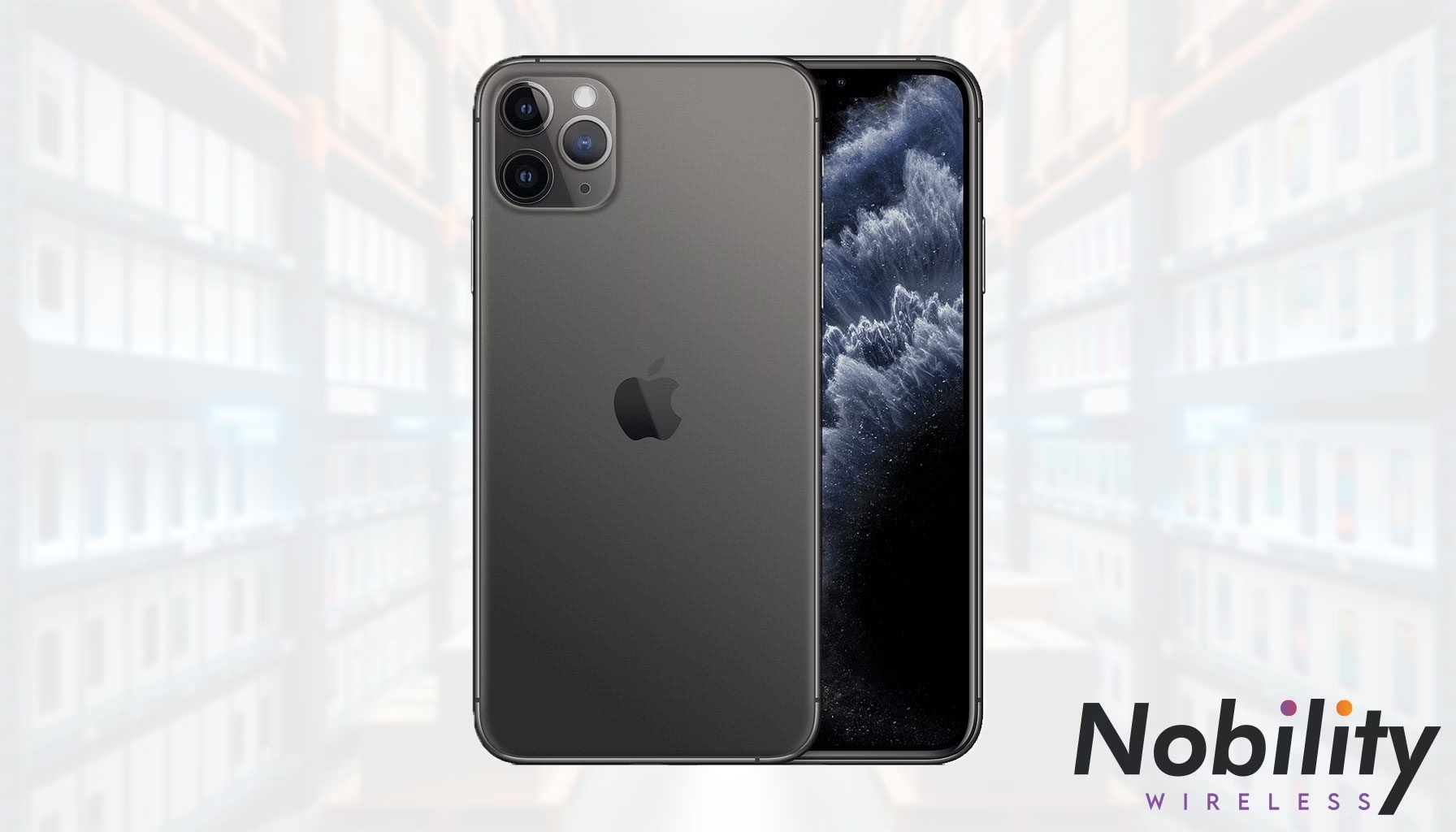
Your procurement budget says mid-tier. Your team’s workload says they need a real device. The iPhone 11 Pro Max is where those two things actually meet — and right now, on the secondary market, it’s one of the most interesting bulk buys in the Apple lineup.
When the iPhone 11 Pro Max launched in September 2019, it retailed at $1,099. It was Apple’s top-of-the-line flagship — the biggest display, the best camera system they’d ever built, the longest battery life in iPhone history at that point. Fast forward to today and you can source the same device, fully certified, through the wholesale secondary market at a fraction of that price. For enterprise IT teams, government procurement officers, nonprofits, and QA labs, that’s a very different value proposition than the one the tech press covered at launch.
I’ve been in this market a long time. The pattern repeats: a device that was “premium” at release becomes “mid-tier” two or three years later on price alone, even though the hardware didn’t change. The iPhone 11 Pro Max is deep in that window right now. The A13 Bionic chip still runs current iOS. The triple-camera system is still genuinely capable. The 6.5-inch Super Retina XDR display didn’t get worse. What changed is the price, and for B2B buyers, that’s the whole story.
The Hardware, Without the Marketing
Let’s talk about what the 11 Pro Max actually is, because the original spec sheet was written for consumers and that’s not who’s reading this.
The A13 Bionic chip — 7nm architecture, 6-core CPU, 4-core GPU, 8-core Neural Engine capable of 600 billion operations per second — was the most powerful mobile processor available when this device launched. Apple described it at the time as a generational leap in mobile processing. That chip is the same one in the iPhone SE (2020), but in the 11 Pro Max it’s paired with more thermal headroom in a larger chassis, which means sustained performance under load — relevant if you’re running intensive apps, processing data in the field, or doing anything beyond basic communication.
The display is a 6.5-inch Super Retina XDR OLED at 458 ppi, with HDR10, Dolby Vision support, and a 2,000,000:1 contrast ratio. It hits up to 1200 nits of brightness. For enterprise use cases where staff are reading documents, reviewing inspection photos, or using the device as a field reference tool — this display is significantly better than most of what’s getting deployed at this price tier.
Battery life was a meaningful step up from earlier Pro models: up to 20 hours of video playback, and real-world all-day performance for heavy users. It supports fast charging (50% in 30 minutes with an 18W adapter) and Qi wireless charging. For shift workers or field staff who can’t always be near a cable, the battery profile matters.
IP68 water and dust resistance — rated to 4 meters for 30 minutes — makes it a legitimate option for environments that aren’t climate-controlled offices. Construction, field services, healthcare, warehousing. The stainless steel frame isn’t just cosmetic, it’s structurally sturdier than the aluminum frames on lower-tier devices.
The Triple Camera: More Relevant Than You Think for Business
I know what you’re thinking — camera specs don’t matter for enterprise. But hear me out, because this comes up more than people expect.
The 11 Pro Max has three 12MP lenses: Ultra Wide (120° field of view, ƒ/2.4), Wide (ƒ/1.8 with dual OIS), and Telephoto (2x optical zoom, ƒ/2.0). Night mode on the Wide lens is genuinely good in low light — not a marketing claim, it’s measurable. DxOMark’s independent camera evaluation at launch ranked it among the top mobile cameras of that generation.
Why does this matter for business? Think about the actual workflows: field inspectors documenting site conditions, healthcare workers capturing wound photos or medication labels, insurance adjusters photographing damage, nonprofit field teams documenting program impact. These are people who need a camera that works in variable lighting without them having to think about it. The Ultra Wide covers room-scale documentation. The Telephoto handles detail shots without getting close. Night mode covers low-light environments like warehouses or evening fieldwork. 4K video at 60fps is there if someone needs to record a site walkthrough or training session.
Deploying a fleet of 11 Pro Max units to a team like that isn’t overkill. It’s appropriate hardware for the actual job.
Where the 11 Pro Max Fits in a B2B Context
Enterprise Fleets and Executive Devices
For enterprise IT teams managing tiered device policies — where most staff get a standard device and certain roles get something better — the 11 Pro Max fills the senior tier without the cost of a current-gen flagship. It runs everything. It supports full MDM management, Apple Business Manager enrollment, and zero-touch provisioning. Your Jamf or Intune workflows apply exactly the same way as they would on a newer iPhone. The difference is you’re spending significantly less per unit for a device that will hold up through a full 3-4 year lifecycle.
App Testing and QA Labs
For app testing teams, the 11 Pro Max represents a specific and still-relevant slice of the iOS install base. It’s running iOS 17, it has the A13 architecture, it has Face ID. If your app needs to be validated on a large-screen OLED iPhone with the triple-camera system — ARKit functionality, camera feature testing, display-sensitive UI rendering — this is the device that covers it. Buying multiples at secondary market pricing lets you build out a proper device matrix without blowing the QA budget on current-gen hardware.
The 6.5-inch form factor is also a distinct screen size bucket. If you’re testing responsive layouts or checking how your UI scales across iPhone sizes, you need to cover this one. The SE (2020) covers 4.7 inches, the 11 Pro Max covers 6.5 — together they bracket a significant portion of the active iOS user base.
Government Agencies
For government procurement, the calculus is usually about security posture, longevity, and justifiable cost. The 11 Pro Max checks those boxes. Apple’s iOS security architecture is well-documented and consistently updated, and Apple’s security research page reflects an ongoing commitment to patching that’s stronger than most of the Android field at any price point. The device supports all current federal mobile security frameworks. And buying refurbished at secondary market pricing gives procurement officers a defensible cost-per-unit that’s much easier to put in front of a budget committee than $800+ current-gen devices.
Nonprofits and NGOs
For nonprofit organizations, the 11 Pro Max is worth a second look specifically because of what the hardware enables at a reduced price. A nonprofit equipping case managers, field coordinators, or program staff deserves devices that actually work — not the lowest-cost option that results in frustration and workarounds. The 11 Pro Max’s battery life, display quality, and camera system make it a device that staff will actually use effectively. And because you’re sourcing through the secondary wholesale market at 20–40% below what new comparable hardware would cost, it’s achievable on budgets that would otherwise only reach a budget-tier device.
What the Secondary Market Price Point Actually Looks Like
Wholesale pricing on the iPhone 11 Pro Max varies by condition grade and storage tier, but on the secondary market you’re generally looking at a range that represents a significant discount from original retail. At fleet scale — 25, 50, 100+ units — the per-unit savings compound quickly.
20–40%
below MSRP — typical wholesale discount on certified refurbished Apple devices
For a fleet of 50 units, that math can free up $5,000–$15,000 in budget depending on which comparable new device you’re pricing against. That’s budget that goes toward MDM licensing, accessories, staging labor, or simply stays in the organization. The device doesn’t get worse because it came through the secondary market — what matters is the QC process it went through before it landed on your desk.
How It Stacks Up Against the Alternatives
Buyers evaluating the iPhone 11 Pro Max are usually comparing it against other Apple options in the same price range, or asking whether to go Android instead. Here’s an honest comparison.
| Device | Chip | Display | Cameras | Battery (video) | 5G | iOS Support | Approx. Wholesale* | Best B2B Fit |
|---|---|---|---|---|---|---|---|---|
| iPhone 11 Pro Max | A13 Bionic | 6.5″ OLED Super Retina XDR, 458 ppi | Triple 12MP (Ultra Wide / Wide / Tele) | 20 hrs | No (LTE) | iOS 17 | $250–$370 | Power users, field docs, QA labs, exec tier |
| iPhone 12 Pro Max | A14 Bionic | 6.7″ OLED Super Retina XDR, 458 ppi | Triple 12MP + LiDAR | 20 hrs | Yes (sub-6 + mmWave) | iOS 18 | $380–$480 | 5G fleets, LiDAR use cases, longer lifecycle |
| iPhone SE (2020) | A13 Bionic | 4.7″ LCD Retina HD, 326 ppi | Single 12MP | 13 hrs | No (LTE) | iOS 17 | $120–$180 | Budget fleets, nonprofits, app testing (small screen) |
| iPhone 12 | A14 Bionic | 6.1″ OLED Super Retina XDR, 460 ppi | Dual 12MP | 17 hrs | Yes (sub-6 + mmWave) | iOS 18 | $200–$290 | Standard enterprise issue, 5G required |
| Samsung Galaxy S21 | Snapdragon 888 | 6.2″ OLED, 421 ppi | Triple camera | 18 hrs | Yes | Android 14 (One UI 6) | $200–$300 | Android MDM fleets, Knox environments |
*Approximate secondary market wholesale pricing by condition grade. Actual pricing varies by volume and availability. Sources: Statista secondary market ASP data; GSMA Circular Economy in Mobile; PhoneCheck device certification.
The 5G Question (Same Answer as Always)
The 11 Pro Max is an LTE device. No 5G. For most enterprise deployments today, that’s not the practical constraint people assume it is. GSMA’s 5G adoption data shows LTE still handles the majority of enterprise mobile traffic globally, and in facility-based environments — offices, hospitals, warehouses, government buildings — Wi-Fi 6 covers the heavy lifting anyway. LTE fills the gaps.
If you’re deploying to field teams in markets with strong 5G coverage and a device lifecycle of four or more years, step up to the iPhone 12 Pro Max or 12. We carry those too. But if your lifecycle is 2–3 years and your use case is primarily data, communication, and documentation — LTE is fine. Don’t pay $130 per unit more for a 5G radio you won’t actually use.
MDM, ABM, and Deployment Readiness
Everything an enterprise IT team needs is here. The iPhone 11 Pro Max supports Apple Business Manager enrollment, zero-touch provisioning, and every major MDM platform — Jamf, Microsoft Intune, VMware Workspace ONE, Mosyle, Kandji. Face ID works with MDM-managed authentication flows. The device can be fully configured, supervised, and locked down before it reaches the end user.
Because the units we ship are unlocked and carrier-agnostic, there’s no lock-status headache at activation. That matters for MVNOs managing their own network activations and for enterprise teams that have carrier contracts they need to honor — either way, the device goes on the carrier you choose, not the one the original buyer happened to use.
For healthcare organizations, worth noting: Face ID works well in most clinical environments, but for teams where masks are part of the routine, an unlock PIN or attention-aware Face ID with mask detection is the workflow. Some healthcare IT teams specifically pair the 11 Pro Max with a strict managed passcode policy for this reason. It’s solvable, just worth planning for at the MDM configuration stage.
QC Is Where This Either Works or Doesn’t
The secondary market for iPhone 11 Pro Max units is active, which means there’s also plenty of low-quality inventory floating around. Battery degradation is the most common issue — a 2019 device that wasn’t well cared for could be sitting at 70% battery health, which means it won’t last through a full work shift. Screen delamination, camera module failures, and lock status problems are real risks with suppliers who don’t do proper diagnostics.
Every iPhone 11 Pro Max that moves through our warehouse goes through a 35-point PhoneCheck inspection. PhoneCheck is the industry-standard third-party diagnostic platform — it tests battery health against a certified threshold, validates all three camera modules, checks touchscreen response across the full display, confirms Face ID function, verifies all connectivity radios, and flags lock status. It’s an auditable record, not a visual pass/fail.
Our return rate across all devices — including the 11 Pro Max — is under 1%. That number is a direct result of the QC process, not a coincidence. When you’re deploying 50 or 100 units to a team, a 5% return rate is a logistics nightmare. Under 1% means your deployment goes as planned.
The full wholesale Apple catalog — from older SE models through current-gen iPhones — is available to qualified B2B buyers. We don’t list prices on a cart because pricing at volume isn’t a one-size number, it depends on condition grade, storage tier, quantity, and what the market looks like when you’re ready to order. The conversation is how it works.
Pricing the iPhone 11 Pro Max for your deployment?
Whether you need 10 units or 500, we work with enterprise IT teams, government agencies, nonprofits, and app testing labs to source certified Apple devices at wholesale pricing. Tell us what you’re building.Contact Us for Wholesale Pricing