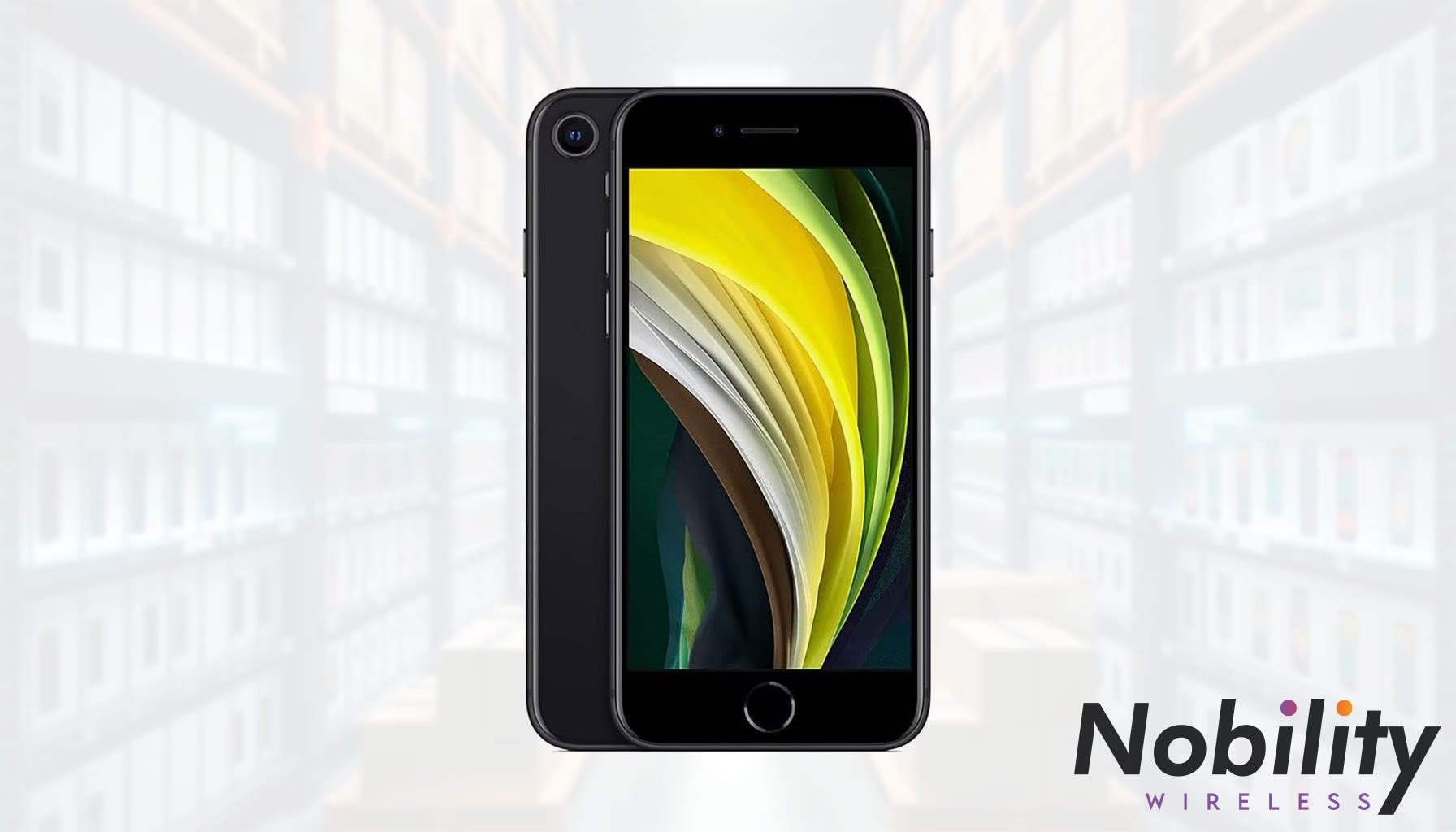
You’ve got a fleet deployment coming up — or a QA lab to equip, or a nonprofit that needs real devices on a real budget — and someone just asked if the iPhone SE (2020) is still worth buying. The answer is yes, and the reasoning is more interesting than you’d think.
The iPhone SE (2020) doesn’t get a lot of attention these days. It came out in April 2020, used the iPhone 8 body that Apple had been making since 2017, and launched at $399 retail. Press coverage was lukewarm. “Dated design,” most reviewers said. But here’s what those reviews missed: for B2B buyers — app testers, enterprise IT teams, government procurement officers, nonprofits stretching every dollar — the SE 2020 hits a combination of specs and price that’s genuinely hard to find anywhere else in the Apple lineup.
I’ve been in the secondary market for mobile devices going on 20 years. I’ve watched buyers chase flagship specs they didn’t need and I’ve watched smart procurement teams save $150 a unit by understanding what actually matters for their use case. The SE 2020 is one of those devices where the secondary market math is just really good, especially right now.
What You’re Actually Getting: The Hardware Case
Let’s start with what matters. The SE (2020) runs on Apple’s A13 Bionic chip — the same processor that powered the iPhone 11 series at launch. That’s not a budget chip. The A13 Bionic has a 6-core CPU, a 4-core GPU, and an 8-core Neural Engine capable of 600 billion operations per second. For app testing — especially if you’re testing machine learning features, ARKit, or anything compute-intensive — this isn’t a compromised device. It’s capable hardware at a fraction of what you’d pay for a current-gen iPhone.
The display is a 4.7-inch Retina HD at 326 ppi with True Tone and P3 wide color. It’s not an OLED, but for most enterprise and field use cases, that doesn’t matter. The Touch ID home button is actually an asset in environments where masks, gloves, or other PPE make Face ID impractical — hospital floors, cleanrooms, food processing, warehouses. There’s a reason some healthcare procurement teams specifically ask for Touch ID devices.
The 12MP rear camera supports Portrait mode, Smart HDR, 4K video up to 60fps, and optical image stabilization. For documentation workflows, field inspection apps, or any deployment where the camera is part of the job — this is more than enough camera.
On connectivity: Wi-Fi 6 (802.11ax), Bluetooth 5.0, NFC with Apple Pay, and it supports the full range of LTE bands. It’s carrier-agnostic when you’re buying unlocked through the secondary market, which matters a lot for organizations running their own MVNO or switching carriers.
Where the SE 2020 Fits (And Where It Doesn’t)
I’ll be straight with you — this isn’t the right device for every deployment. But for several high-volume B2B use cases, it’s one of the better options in the catalog right now.
App Testing and QA Labs
If you’re a QA team or dev shop maintaining a device lab for app testing, the SE 2020 solves a specific problem: you need real Apple hardware running a specific iOS version, and you need it cheap enough to buy multiples. The A13 handles modern iOS builds without throttling. You can lock it to an older OS for regression testing or keep it current. The compact form factor is also relevant — 4.7 inches is still a real segment of the iPhone user base, and if your app needs to be tested at that screen size, this is your device.
Buying through the secondary wholesale market, these units come in well under what you’d pay retail, and when you’re equipping a lab with 15 or 20 devices across different models and OS versions, that spread adds up fast.
Nonprofits and NGOs
For nonprofit organizations equipping field workers, case managers, or program participants, the SE 2020 is about as good as it gets for the price point. It runs the latest iOS, supports MDM enrollment through Apple Business Manager, and it’s a real iPhone — not a compromised handoff from a carrier clearance bin. Organizations operating on grant budgets or donor dollars can typically equip significantly more people per dollar with refurbished SE 2020 units than with any current-gen device.
Enterprise Fleets and Field Devices
For enterprise IT teams deploying managed devices to field staff, technicians, or frontline workers, the SE 2020 checks the boxes that actually matter for fleet management: Apple Business Manager support, zero-touch enrollment via ABM, full MDM compatibility, and enough processing power to run whatever line-of-business apps your team needs. The compact size also means it fits in a shirt pocket or work vest without being an issue — practical detail that matters for field deployments.
Fleet replacement cycles often run 3–4 years, and the SE 2020 still has runway. Apple supported iOS 17 on this device, and the A13 architecture has enough headroom that it’s not getting dropped in the near term.
Government Procurement
For government agencies buying under budget constraints, the SE 2020 sits in a category that’s hard to find: an Apple device with strong security posture, current iOS support, and a price point that doesn’t require the same justification as a flagship. Government procurement tends to be risk-averse, and Apple’s track record on security updates is genuinely better than the Android field — the SE 2020 benefits from that reputation while costing significantly less per unit than newer models.
The Real Cost Comparison: New vs. Wholesale Refurbished
Here’s where the conversation usually turns. Wholesale pricing on Apple devices through the secondary market typically runs 20–40% below MSRP, and on a model like the SE 2020, you’re looking at savings of $100–$200 per unit compared to buying new equivalent-tier devices. At fleet scale — say 50 or 100 units — that’s real budget freed up for accessories, MDM licensing, staging labor, or simply staying within what was approved.
$100–$200
typical per-unit savings vs. new retail, at fleet scale
The caveat — and this is the part where a lot of buyers get burned — is that not all secondary market devices are equal. I’ve seen units come through with degraded batteries, failed touchscreens flagged as passing, and carrier locks that didn’t show up until activation. That’s why QC process matters more than almost anything else when you’re sourcing refurbished Apple devices in volume.
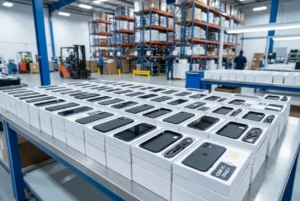
Every iPhone SE (2020) that moves through our warehouse goes through a 35-point PhoneCheck inspection — PhoneCheck is the industry standard for certified device diagnostics, and it catches the things visual inspection misses. Battery health, touch response across the full display, camera function, speaker output, all connectivity modules. Our return rate across all devices is under 1%, and that number comes from having a real QC process, not just a visual pass/fail.
iPhone SE (2020) vs. Comparable Options: How It Stacks Up
Buyers evaluating the SE 2020 are usually comparing it against a few alternatives — newer SE models, Android equivalents, or older flagship iPhones. Here’s an honest look at how they compare for B2B use cases.
| Device | Chip | Display | 5G | Touch ID | iOS Support | Approx. Wholesale Price* | Best B2B Fit |
|---|---|---|---|---|---|---|---|
| iPhone SE (2020) | A13 Bionic | 4.7″ LCD Retina HD | No (LTE) | Yes (home button) | iOS 17 | $120–$180 | App testing, nonprofits, budget fleets |
| iPhone SE (2022) | A15 Bionic | 4.7″ LCD Retina HD | Yes (sub-6) | Yes (home button) | iOS 18 | $200–$260 | Fleets needing 5G, government |
| iPhone 11 Pro Max | A13 Bionic | 6.5″ OLED Super Retina XDR | No (LTE) | No (Face ID) | iOS 17 | $250–$370 | Exec deployment, high-res content teams |
| iPhone 12 | A14 Bionic | 6.1″ OLED Super Retina XDR | Yes (sub-6 + mmWave) | No (Face ID) | iOS 18 | $200–$290 | 5G fleets, enterprise standard issue |
| Samsung Galaxy A14 5G | Dimensity 700 | 6.6″ LCD | Yes | Yes (side-mounted) | Android 13–14 | $100–$150 | Android MDM fleets, MVNOs, cost-first deployments |
*Approximate secondary market wholesale pricing. Actual pricing varies by condition grade, volume, and market availability. Contact us for current pricing. Sources: Statista secondary market ASP data; GSMA Circular Economy report.
The 5G Question
It comes up every time. The SE 2020 doesn’t have 5G — it maxes out at LTE. For most enterprise use cases right now, that’s not a practical limitation. GSMA’s 5G deployment data shows that LTE still handles the overwhelming majority of enterprise mobile data traffic, and in many markets, 5G coverage in field or warehouse environments is limited anyway. If you’re equipping a device lab, a nonprofit field team, or a fleet of frontline workers in a facility with solid Wi-Fi — 5G is not the bottleneck you’re optimizing for.
That said, if 5G matters for your deployment — outdoor field teams in well-covered markets, or organizations planning a 4+ year device lifecycle — the SE 2022 or iPhone 12 are worth the step up in price. We carry both. But don’t let 5G be a checkbox that costs you $80 per unit you didn’t need to spend.
MDM, ABM, and Deployment Readiness
This is the part that matters most for IT teams and actually gets skipped in most device write-ups. The SE 2020 supports full Apple Business Manager enrollment, zero-touch provisioning, and every major MDM platform — Jamf, Intune, VMware Workspace ONE, Mosyle, you name it. Devices purchased through the right wholesale channel can be enrolled in ABM before they ever arrive at your door, which means your team isn’t manually configuring 50 phones one by one.
The devices we ship are unlocked and carrier-agnostic, so you’re not fighting lock status at activation. That alone has saved more than a few IT managers a genuinely bad week.
For healthcare organizations in particular — hospital systems, clinical networks, home health agencies — the Touch ID on the SE 2020 is a real operational advantage. Staff wearing gloves can authenticate with a registered knuckle. Face ID doesn’t work under a mask. Small thing, but in a clinical environment it matters every single shift.
What Condition Grading Actually Means
When you’re buying refurbished Apple devices wholesale, condition grading is where a lot of buyers get surprised. Grade A, Grade B, “like new,” “excellent” — these terms aren’t standardized across the industry, and different suppliers use them differently. What you actually want to know is: what’s the battery health minimum, what cosmetic standards are being enforced, and is there a third-party diagnostic certification attached to the unit.
PhoneCheck certification gives you an auditable record of what was tested and what passed. It’s not a marketing claim, it’s a data record. When we say our devices pass a 35-point inspection, that’s what we’re talking about — documented diagnostics, not a visual once-over.
Our sub-1% return rate reflects what happens when QC is actually done right. It’s not a number we put up because it sounds good, it’s what the data shows after years of volume.
Is the SE (2020) Still a Smart Buy in 2025?
For the right buyer, yes. The A13 chip still has performance headroom, iOS 17 support keeps it in a manageable security posture, and the secondary market price point makes it one of the better value propositions in the Apple ecosystem right now. It’s not a device you’d deploy if 5G is a hard requirement, or if your organization’s standard issue is moving toward the iPhone 13/14 tier. But for a QA lab, a nonprofit doing first-time device distribution, a government agency equipping seasonal or part-time staff, or an enterprise building out a secondary device pool — it earns its place.
We carry the SE 2020 as part of our wholesale Apple catalog, alongside the full iPhone lineup from SE through current-gen. If you’re evaluating which model fits your deployment, we can walk through the tradeoffs — chip generation, iOS longevity, condition grades, ABM enrollment options, and what the actual per-unit cost difference looks like at your volume.
No catalog, no cart, no automated quote. Just a real conversation about what you actually need.
Ready to talk iPhone SE (2020) pricing for your deployment?
We work exclusively with qualified B2B buyers — fleets, nonprofits, app testing teams, IT departments, and government agencies. Tell us what you’re building and we’ll give you straight answers.Contact Us for Wholesale Pricing