Best Practices for Bulk Smartphone Procurement in Large Enterprises: A 7-Step Guide for IT Buyers

B2B procurement workspace with unlocked wholesale phones and a printed checklist for evaluating a wholesale phone distributor

Bulk smartphone procurement in a large enterprise looks nothing like buying a personal phone. You’re not choosing a device — you’re deploying a fleet. Hundreds or thousands of units that need to survive shipping, pass QC, enroll in your mobile device management platform, activate on the right carrier, and hold up over three to five years of daily use in the hands of people who did not pick them. Get the process right and the deployment fades into the background of everyday work. Get it wrong and IT is running a permanent triage operation.

The mistakes are almost always upstream, in how the purchase was structured. Enterprises that get bulk smartphone procurement right treat it as an operational commitment, not a one-time purchase — with specifications, vendor requirements, and lifecycle planning locked in before the first order goes out. Here are the seven best practices that separate deployments that work from deployments that don’t.

1. Define the Deployment Before Defining the Purchase

The most expensive procurement mistakes happen when IT buys devices before the deployment is scoped. Bulk smartphone procurement should always start with a written specification that covers: who the users are, what applications they’ll run, what security controls apply, what carriers they’ll activate on, and what the device replacement cycle looks like.
Enterprise IT and procurement team reviewing a bulk smartphone deployment plan in a corporate conference room
Bulk smartphone procurement decisions involve IT, procurement, and finance together.

A field service technician needs a durable device with strong battery life and a workable camera. A finance team executive needs a flagship with premium security features. A retail associate needs a compact device that can withstand a 4-foot drop onto tile. These aren’t the same purchase — and treating them as one is how enterprises end up with 500 units of the wrong device for 40% of the deployment.

Standardize on no more than two or three device SKUs per role. Fewer SKUs mean simpler MDM policies, faster imaging, cleaner spare-pool management, and lower total support cost across the fleet.

2. Choose the Right Device Tier: New, Refurbished, or Certified Pre-Owned

Enterprises with unlimited budgets buy new. Everyone else evaluates all three tiers on a per-role basis.

New devices make sense for security-sensitive roles (executive team, legal, compliance), for pilots of unreleased hardware, and for deployments where full manufacturer warranty coverage is a compliance requirement.

Certified pre-owned (CPO) devices are inspected, tested, and warrantied by a wholesale distributor to a defined grade. They’re typically 30–50% below new pricing for hardware that’s one to two generations old but still fully supported by iOS or Android security updates. For most enterprise fleet deployments — retail, field services, healthcare, warehouse — CPO is the right economic answer.

Refurbished devices occupy the same range as CPO but the grading standards vary wildly by supplier. If your distributor can’t produce a written grading manifest, you’re not buying refurbished — you’re buying used with a nicer name.

Match the tier to the role, not the budget line. Deploying flagship new phones to warehouse teams is a waste; putting used devices in the hands of your executive team is a security incident waiting to happen.

3. Require Unlocked Devices for Carrier and MDM Flexibility

Carrier-locked devices are optimized for retail consumer sales, not enterprise deployment. In bulk smartphone procurement, unlocked devices give you three things that carrier-locked cannot: freedom to negotiate with any carrier (including MVNOs that can meaningfully undercut Tier 1 rates on high-volume plans), portability if you switch carriers mid-lifecycle, and cleaner MDM enrollment without carrier-imposed constraints.

Unlocked also matters for international deployments. If any portion of your workforce travels or works cross-border, unlocked devices activate on local SIMs without a support ticket to the carrier’s business team.

The premium for unlocked devices in the wholesale channel is typically negligible when volume is right. Insist on it.

4. Validate MDM/EMM Compatibility Before Ordering

The single most preventable enterprise smartphone deployment failure is buying devices that don’t enroll cleanly in the organization’s mobile device management platform. Different MDM/EMM platforms — Microsoft Intune, VMware Workspace ONE, Jamf, Google Workspace endpoint management — have different device eligibility requirements and enrollment pathways.

For Android, validate that devices support Android Enterprise zero-touch enrollment. For iOS, validate that devices are eligible for Apple Business Manager and Automated Device Enrollment. Both platforms require the distributor to be registered as an authorized reseller before enrollment records can be pushed to your MDM tenant.

Ask your wholesale phone distributor two questions before the order: “Are you an authorized reseller for zero-touch / ABM enrollment?” and “Can you provide the enrollment records at time of shipment so devices arrive pre-registered to our MDM?” If the answer to either is no, the devices will still work — but your IT team is going to spend an extra 15 minutes per device manually enrolling them, and that time multiplied by fleet size is the hidden cost buyers miss most often.

5. Standardize Grading and IMEI Verification Requirements in the RFQ

Grading standards vary wildly across wholesale suppliers. “Grade A” at one distributor is “Grade B” at another, and buyers who don’t lock in written grading definitions before the first shipment are the ones who end up with quality disputes on delivery. If you’re not sure how to evaluate this before ordering, our guide on how to evaluate a wholesale phone distributor walks through the full vendor qualification process.

In your RFQ, require the following as a baseline: written grading tier definitions with specific criteria (screen condition, housing condition, functionality), 100% device inspection (not spot-checking), IMEI cleanliness verification against carrier blacklists, battery health minimums on Apple devices (typically 85% or higher for CPO), and a manifest at time of shipment listing every IMEI with its grade.

The manifest matters more than most buyers realize. It’s what your finance team needs for asset tracking, what your compliance team needs for chain-of-custody, and what your IT team needs when a device fails and you’re trying to figure out whether it shipped that way.

6. Plan Staged Delivery and Require Chain-of-Custody Documentation

Bulk smartphone procurement is a logistics problem as much as a purchasing problem. A 1,000-unit shipment arriving at a single dock on a single day overwhelms most receiving teams. IT ends up scrambling, devices sit unboxed, and the deployment stretches into weeks because nobody planned staging.

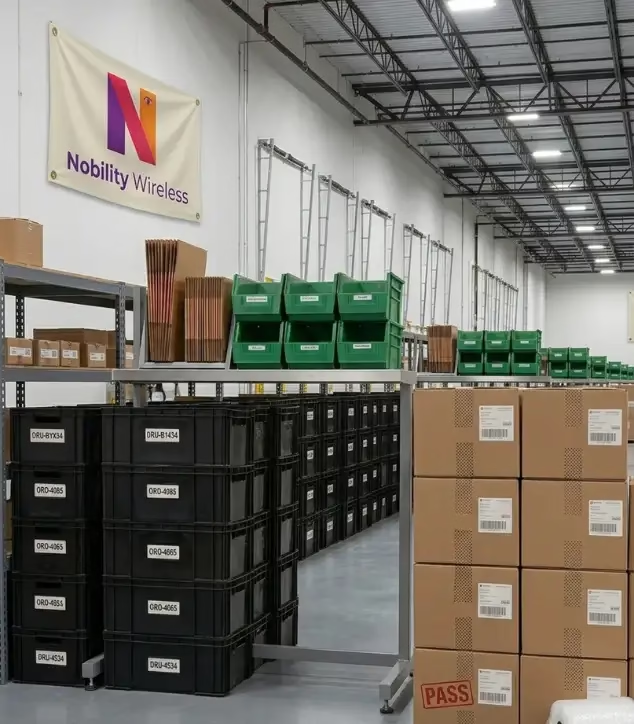
Wholesale smartphone pallet staged for enterprise deployment in a US distribution warehouse aisle

Instead, structure the order in waves that match your deployment schedule. If you’re rolling out to 14 branches over four weeks, ship in four waves of 250 units — each matched to the branch schedule. Your distributor should be willing to hold staged inventory and release on your calendar. If they can’t, they’re not set up for enterprise deployment.

Every shipment should include chain-of-custody documentation: the manifest, the QC diagnostic report per device, and a receiving acknowledgment. For regulated industries — healthcaregovernment, financial services — chain-of-custody isn’t optional. It’s the audit trail your compliance team will ask for months later and either have or not have.

7. Design for the Full Lifecycle, Not Just Deployment

Devices are not a one-time purchase — they’re a three-to-five-year operational commitment. Bulk smartphone procurement that only accounts for the day-one purchase is procurement done wrong.

Build the following into the procurement plan from the start:

  • Spare pool: Order 5–8% above headcount to cover DOA replacements, in-service failures, and new hires without emergency reorders.
  • Refresh cycle: Plan a 3-year refresh for iOS (Apple’s typical iOS support lifecycle), 3–4 years for Android depending on manufacturer commitment to security updates.
  • Buyback / trade-in: Negotiate residual-value terms with your distributor at time of initial purchase. End-of-life devices retain 15–40% of purchase price if returned in graded condition. Waiting until refresh time to negotiate residuals leaves money on the table.
  • Secure disposal: For devices that can’t be resold, require certified data wiping and disposal per NIST SP 800-88 media sanitization guidelines. Your compliance team will ask; your distributor should already have this.

Enterprises that treat lifecycle as a first-order concern pay 20–35% less over five years than enterprises that treat each purchase as an event.

Quick Reference: The 7 Best Practices at a Glance

Best PracticeWhat to RequireCommon Failure Mode
Define deployment firstWritten spec per role: users, apps, security, carrierBuying before scoping
Choose device tierNew / CPO / refurbished matched to roleOne-tier-fits-all across the fleet
Insist on unlockedFactory unlocked, carrier-agnosticCarrier-locked devices from consumer channels
Validate MDM compatibilityZero-touch / ABM enrollment at shipmentManual enrollment at scale
Standardize grading + IMEIWritten definitions, 100% inspection, clean-IMEI guaranteeVague “Grade A” claims
Stage deliveryWave shipments matched to deployment calendarOne dock, one day, chaos
Design for lifecycleSpare pool, refresh cycle, buyback, disposalDay-one thinking only

What the Right Distributor Brings to Enterprise Procurement

A distributor built for consumer resale isn’t set up for enterprise deployment — no matter how competitive their pricing looks on the RFQ. Enterprise-grade bulk smartphone procurement requires a supplier who can commit to written grading standards, run authorized zero-touch and ABM enrollment, support staged delivery on your calendar, provide the documentation your compliance team needs, and stand behind the QC process when a shipment doesn’t match spec.

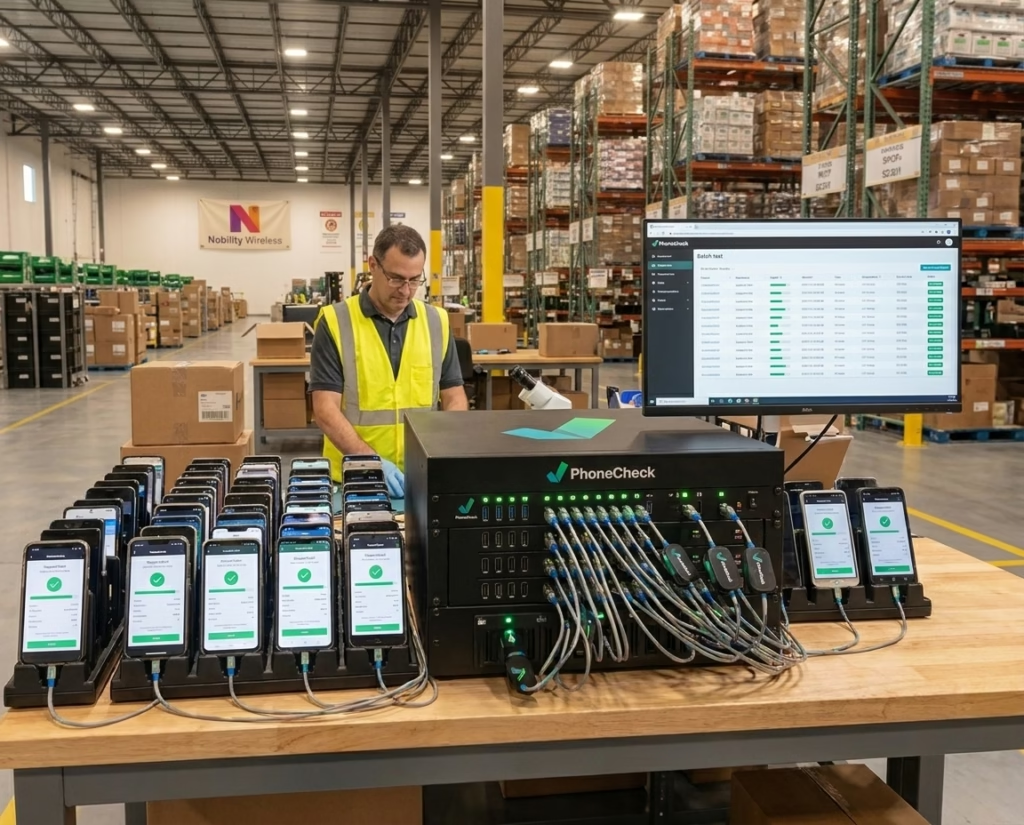
At Nobility Wireless, every device runs through a 35-point PhoneCheck inspection before shipment, with a sub-1% return rate across more than a million devices deployed. We work directly with enterprise IT, procurement, and MDM teams — not through a portal, not through a chatbot.

Ready to Talk About Your Deployment?

Nobility Wireless supplies wholesale smartphones and wholesale tablets to enterprise IT, healthcare, government, and MVNO teams from our Hollywood, FL warehouse. Every order includes IMEI verification, written grading, chain-of-custody documentation, and MDM-ready configuration on request. Contact us to discuss your fleet requirements.

What is bulk smartphone procurement?

Bulk smartphone procurement is the process by which enterprises source and purchase smartphones at scale — typically 50 or more units per order — through a wholesale distributor rather than through consumer retail channels. It involves specification standardization, vendor qualification, MDM compatibility validation, grading requirements, staged delivery, and lifecycle planning.

How many smartphones count as a bulk order?

Definitions vary by distributor, but “bulk” in the enterprise channel typically starts around 25–50 units. Below that, most organizations buy through carrier business programs or retail. Above that, wholesale procurement offers meaningfully better pricing, unlocked device availability, and enterprise-focused services like zero-touch enrollment and staged delivery.

Should enterprises buy new or certified pre-owned smartphones?

Most enterprise deployments benefit from a mix. New devices are appropriate for security-sensitive roles and short-lifecycle deployments. Certified pre-owned (CPO) devices are 30–50% below new pricing and are appropriate for most standard fleet roles — retail, field services, healthcare, warehouse. Match the tier to the role, not the entire fleet.

Do enterprise smartphones need to be unlocked?

Yes, in almost all cases. Unlocked devices give enterprises the flexibility to negotiate with any carrier (including MVNOs), simplify MDM enrollment, and support international deployment or travel. The premium for unlocked in the wholesale channel is typically negligible at enterprise volumes.

How do enterprises verify a wholesale distributor is ready for bulk smartphone procurement?

Ask for: written grading standards, zero-touch / ABM authorized reseller status, IMEI cleanliness guarantees, staged delivery capability, chain-of-custody documentation, and references from other enterprise customers. Any distributor that can’t meet all six is set up for consumer channels, not enterprise deployment.

More Posts

Scroll to Top

Get Exclusive Access to Wholesale Mobile Device Pricing

Tell us a little about your needs and your organization.
We work exclusively with qualified partners looking to purchase in volume.