Are you still buying phones through a carrier or retail channel and wondering why your per-unit costs keep climbing? If you’re managing device procurement for a business — whether it’s 15 phones or 1,500 — there’s a better way to do it. Wholesale mobile phones for business have become the default for procurement teams, IT managers, and operations leads who’ve done the math. This is why.
The shift to the wholesale channel isn’t new. I’ve watched it happen over the past two decades — first in the refurb market, then as enterprise mobility grew into its own procurement category. What’s changed is how many more organizations are making the move now. MVNOs, healthcare networks, government agencies, insurance carriers, non-profits — they’ve all figured out that going direct on device sourcing is smarter, cheaper, and a lot less painful than the retail alternative.
1. The Per-Unit Math Actually Works
Retail pricing is built for individuals. Every layer — the carrier, the storefront, the activation subsidy, the financing desk — adds margin. When you strip all that out and buy wholesale, you’re typically looking at 20–40% below MSRP. On modern smartphones that’s $100 to $400 saved per device. For a 200-unit refresh, that’s a real budget conversation.
Wholesale mobile phones for business aren’t discounted because they’re inferior — they’re priced this way because you’re buying direct and you’re buying volume. That’s how distribution has always worked.
2. Factory Unlocked Means You Own the Decision
Carrier-locked devices are a trap. You pay full price (or close to it), you’re tied to one network, and when coverage or pricing changes, your hands are tied. Every device we ship is factory unlocked — works on any compatible network, anywhere.
For MVNOs building subscriber fleets, this is non-negotiable. For enterprise IT teams managing multi-site deployments with different regional carriers, it’s just common sense. You choose the network. You keep that flexibility on every renewal cycle.
3. MDM-Ready Out of the Box
This is where a lot of IT managers get burned buying from retail. The device shows up, it’s on a carrier plan, and now your team is spending hours stripping it down before you can even think about enrollment. Wholesale devices don’t come with that baggage.
Our inventory is fully compatible with Knox, Android zero-touch enrollment, and Apple Business Manager. You can push your MDM configuration before the device ever reaches an end user — sometimes before it even leaves our dock. For enterprise IT teams, that’s the difference between a deployment day and a deployment week.
4. No Strict Minimums — Order What You Actually Need
One of the bigger misconceptions about wholesale is that it’s only for massive orders. It’s not. Not every procurement cycle is a 500-unit rollout. Sometimes you need 12 devices for new hires in Q3 and 300 more in Q1 when the contract kicks in. We work with orders from 10 to 10,000+, and the pricing scales with you.
The supply chain stays consistent regardless of order size. You’re not hunting for stock every time you need a refresh.
5. QC That Actually Holds Up
This is the one I feel most strongly about, because I’ve seen what happens when it isn’t there. Devices that look fine on paper arrive with dead pixels, degraded batteries, or mic issues — and then your IT helpdesk becomes a device repair queue.
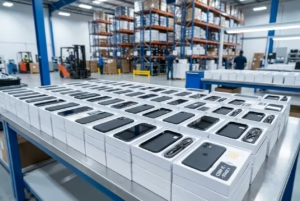
Every device we ship goes through a 35-point PhoneCheck inspection. Battery health, display, cameras, speakers, biometrics, sensors — all of it gets verified before it leaves. Our return rate is under 1%. That’s not marketing copy, that’s operational data. For teams running tight provisioning timelines, that kind of reliability matters more than almost anything else.
6. Procurement Teams Get a Real Process
Consumer retail wasn’t designed for purchasing departments. There’s no PO process, no consolidated shipping, no documentation that plays nicely with asset tracking systems. Buying wholesale is different — shipments arrive consolidated, properly documented, and ready to integrate with your receiving workflow.
For procurement leads managing asset lifecycles across departments or facilities, this alone justifies the channel switch. You’re not chasing 40 separate tracking numbers from 40 separate carrier orders.
7. Healthcare and Government Deployments Have Requirements Retail Can’t Meet
If you’re sourcing devices for a healthcare network or a government agency, you already know the procurement environment is different. You need audit trails, provisioning compatibility with institutional MDM platforms, and devices that can be locked down to specific apps or network segments.
Factory-unlocked, MDM-ready wholesale devices meet those requirements without the carrier overhead. Carrier contracts exist to serve the carrier’s interests. Wholesale procurement exists to serve yours.
8. Insurance Carriers and Retail/E-Comm Have Their Own Case
It’s not just the obvious enterprise buyers. Insurance companies sourcing replacement devices for policyholders need consistent supply, fast turnaround, and verified device condition — you can’t hand a customer a replacement that fails in two weeks. Similarly, retail and e-commerce businesses selling refurbished or unlocked devices need a reliable upstream source with real QC behind it.
Both of those use cases depend on a supply chain that treats quality as a hard requirement, not a suggestion.
9. Non-Profits Get Purchasing Power They Couldn’t Have Otherwise
Wholesale pricing isn’t just for large enterprises. Non-profit organizations distributing devices to underserved communities, workforce training programs, or social service clients can access the same per-unit economics as a Fortune 500 IT department. The devices are factory unlocked, QC-verified, and ready to deploy — which matters a lot when you’re operating on a tight program budget and can’t afford a wave of defective returns.
10. Fulfillment Flexibility Changes the Logistics Equation
Sourcing the devices is one problem. Getting them where they need to go is another. Wireless fulfillment at scale — shipping to multiple sites, staging devices for specific deployments, coordinating delivery windows — is something a wholesale partner handles as part of the relationship. Retail channels aren’t built for that. They ship to an address. That’s it.
For organizations managing multi-site rollouts or ongoing subscriber fulfillment, that logistics capability is part of what you’re actually buying when you go wholesale.
Wholesale vs. Retail: How the Channels Actually Compare
| Factor | Wholesale | Retail / Carrier |
|---|---|---|
| Per-unit cost | 20–40% below MSRP | Full retail or financed |
| Network flexibility | Factory unlocked, any carrier | Carrier-locked by default |
| MDM / enrollment | Knox, zero-touch, ABM-ready | Requires manual setup |
| QC process | 35-point inspection, <1% return rate | Manufacturer standard only |
| Order minimums | 10 to 10,000+ units | No bulk pricing structure |
| Procurement process | PO-friendly, consolidated shipping | Designed for individual buyers |
| Fulfillment support | Multi-site, staged deployments | Ships to one address |
Sub-1%
return rate across our entire device catalog — verified by 35-point PhoneCheck inspection on every unit
If you’re still sourcing wholesale mobile phones for business through retail or carrier channels, it’s worth doing the math on what that’s actually costing you — not just in dollars per unit, but in deployment time, logistics friction, and the downstream cost of device failures in the field.
The wholesale channel exists because procurement at scale has different requirements than buying a phone for yourself. That’s not complicated. It’s just how distribution works when the buyer is a business, not a person.
Ready to price out your next device order?
From 10 units to 10,000+, we’ll get you pricing and availability based on your volume and model requirements — no obligation.Request a Quote