
Is your IT department struggling to manage a fragmented fleet of corporate mobile devices? In the fast-evolving landscape of enterprise mobility, one trend is clear: iPhones for business have become the gold standard. Whether you’re managing a fast-moving enterprise or a highly regulated logistics firm, standardizing on Apple devices reduces support tickets, lowers long-term overhead, and keeps company data secure.
But why has the iPhone business phone become the default for IT teams across enterprise, healthcare, financial services, and government? Based on insights from IT professionals across enterprise and cybersecurity communities, here’s why organizations choose to standardize on Apple.
- Zero-Touch Enrollment: Seamless out-of-the-box setup via Apple Business Manager and Device Enrollment Program.
- Immediate Security Patches: Direct iOS updates bypass carrier and OEM approval delays.
- Lower Total Cost of Ownership: High residual resale value and 5–7 year guaranteed support lifecycle.
- MDM-Native Design: Deep integration with Microsoft Intune, Jamf, VMware Workspace ONE, Kandji, and Mosyle.
1. Seamless MDM Compatibility and Enterprise Security
Mobile Device Management (MDM) is essential for securing corporate mobile fleets. IT professionals consistently highlight that iPhones integrate cleanly with major MDM platforms including Microsoft Intune, Jamf, VMware Workspace ONE, Kandji, and Mosyle.
Because Apple maintains absolute control over its hardware and operating system, policy enforcement is highly predictable. Your IT team can enforce data encryption, push remote wipes, and restrict unauthorized applications with far less friction than Android’s fragmented environment — which is why the iPhone as business phone is the default in regulated industries like healthcare, financial services, and government.
Do you need your devices pre-configured before they arrive? Learn how we pre-install MDM software on devices before deployment to save your operations team hours per rollout.
2. Faster, Friction-Free iOS Updates
Security vulnerability management is a major headache for B2B ops teams. On Android, operating system updates are delayed by manufacturers (OEMs) and carrier approval cycles — sometimes by months, sometimes indefinitely.
With Apple, security patches and major iOS versions ship directly to every active device the day they’re released. Your entire fleet gets critical updates immediately, protecting corporate data from emerging mobile threats. As one enterprise IT admin put it: “With iPhones, updates just work. There are no layers of delay with third parties in the middle.”
3. Industry-Leading Device Lifecycles and High ROI
One of the most compelling B2B arguments for the business phone iPhone is longevity. iPhones typically receive operating system and security updates for 5 to 7 years after their release date.
- Fewer upgrade cycles: Instead of replacing budget Android devices every 2 years, Apple devices offer a secure, high-performance operational lifespan of up to 7 years.
- Exceptional resale value: When it finally is time to upgrade, iPhones retain a much higher residual value than competing brands, dramatically reducing your lifetime hardware costs.
- Predictable procurement cadence: Apple’s annual release schedule and long support tail let procurement teams plan refresh budgets 3–5 years in advance.
If you’re weighing employee-owned devices against company-issued Apple hardware, we break down the pros, cons, and security considerations in our Company Phones vs BYOD MDM guide.
4. Simplified, Scalable Procurement
Standardization is the easiest way to cut IT overhead. Rather than troubleshooting dozens of Android models with different firmware versions, your team can standardize on a tiered Apple strategy:
- iPhone SE (3rd Gen): Budget-conscious, high-volume deployments — healthcare intake, retail associates, field logistics.
- iPhone 15 / 16 / Air: Mid-tier corporate standard — sales teams, everyday employee fleets.
- iPhone Pro Series: Executives, developer teams, security-sensitive roles.
To streamline your selection process and avoid costly purchasing mistakes, check out our guide to evaluating a wholesale phone distributor before finalizing your Apple procurement partner.
5. Integrating with Apple Business Manager (ABM)
For truly automated IT workflows, register your hardware through the Device Enrollment Program via Apple Business Manager. This lets devices automatically install your corporate MDM profile the first time they’re powered on — making zero-touch onboarding a reality for remote staff, field teams, and multi-location rollouts.
Every iPhone as business phone shipped from Nobility Wireless can be pre-registered to your ABM tenant before it leaves our facility, so devices auto-enroll into Intune, Jamf, or Workspace ONE on first power-on at your site.
Frequently Asked Questions About iPhones for Business
Why do so many companies choose iPhones for business over Android?
How does Apple Business Manager work with corporate iPhones?
What MDM platforms work best with iPhones for business?
How long do iPhones last as business devices?
Should I buy new or refurbished iPhones for business use?
Can iPhones be pre-configured before shipment?
Partner with Nobility Wireless for Your Enterprise Apple Deployment
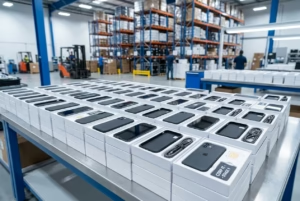
Procuring bulk, enterprise-ready mobile devices shouldn’t be a logistical headache. At Nobility Wireless, we supply fully tested, unlocked, and certified business-ready iPhones at competitive wholesale pricing to fit any scale — from 25-unit branch refreshes to 10,000+ unit MVNO activation programs.
From initial kitting and custom MDM provisioning to reliable, rapid shipping via 3PL-compatible fulfillment, we make sure your team gets the exact hardware they need to stay productive. See our wholesale iPhone and iPad inventory for current models, grades, and availability.
Got questions? Call our B2B procurement team at (305) 745-7038 or request a bulk iPhone quote to secure live-inventory pricing.