
You’re about to spend tens of thousands of dollars on devices for your organization. How confident are you, really, in where those phones are coming from?
If you’re trying to figure out how to buy cell phones wholesale — for the first time or after getting burned by a bad supplier — this is the post for you. I’ve spent 20 years in this industry, starting out on the refurbishing floor and eventually watching the B2B wholesale market evolve from a scrappy secondary channel into a serious procurement option for enterprises, healthcare systems, government agencies, and MVNOs. And one thing hasn’t changed: most buyers still don’t know what to ask before they sign a purchase order.
Let’s fix that.
Wholesale vs. Retail: It’s Not Just About the Price
Yes, when you buy cell phones wholesale you save money. Typically 20–40% below MSRP, and depending on the model, that’s $100–$400 in savings per unit. For a fleet of 200 devices, that math gets interesting fast.
But price is actually the least interesting part of the wholesale conversation for serious B2B buyers.
When you buy retail — through a carrier store or a consumer electronics chain — you’re buying one device at a time, with consumer-grade support, and no infrastructure for fleet management. When you buy wholesale, you’re entering into a supply relationship. You need consistency. You need devices that arrive in predictable condition, with predictable specs, ready to deploy. The difference between a good wholesale supplier and a bad one isn’t the price on the quote, it’s what happens after you wire the money.
Unlocked Devices Matter More Than You Think
This is one of the first things I talk through with procurement teams. Carrier-locked devices look cheaper on paper, sometimes they are. But if you’re managing a fleet across multiple locations, multiple networks, or you’re an MVNO building out your own service, carrier-locked bulk devices are a headache waiting to happen.
When you buy cell phones wholesale through the right supplier, you should be getting unlocked, carrier-agnostic devices. That means network flexibility — you’re not tied to one carrier’s coverage map, one carrier’s pricing, or one carrier’s timeline for unlocking when you need to reassign a device. For enterprise IT teams especially, that flexibility is worth real money, even if it’s harder to quantify on a spreadsheet.
The other thing: unlocked devices are significantly easier to manage at scale. You provision them yourself, on your MDM platform, for your network. No carrier bloatware, no pre-installed apps you have to strip out, no activation hoops to jump through.
$100–$400
Typical savings per unit when buying wholesale vs. retail MSRP
What to Actually Look for in a Wholesale Supplier
I’ve seen IT directors get burned by suppliers who shipped misgraded devices, disappeared after the invoice was paid, or couldn’t maintain consistent inventory across a multi-month rollout. Here’s what you should be asking every supplier before you commit.
How Do They Grade and Inspect Devices?
Every supplier in this industry uses grading terminology — Grade A, Grade B, “like new,” “excellent.” The problem is none of it is standardized. One supplier’s Grade A is another supplier’s Grade B. What you want to know is: what’s the actual inspection process behind the grade?
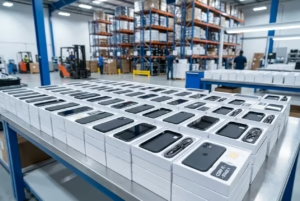
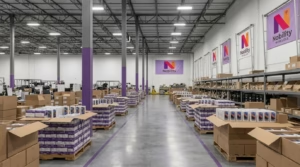
At Nobility Wireless, every device goes through a PhoneCheck-certified 35-point QC inspection. That’s not a visual once-over, it’s a systematic functional test — battery health, cellular connectivity, cameras, speakers, biometrics, the works. It’s why our return rate sits under 1%, which in this industry is genuinely hard to achieve.
Can They Handle Consistency at Scale?
A supplier who can fill a one-time order of 50 units isn’t necessarily a supplier who can support a 500-unit rollout over six months. Ask about catalog depth, inventory turnover, and whether they can commit to specific models across multiple purchase orders. Our catalog runs over 100 devices — Samsung, Apple, Google Pixel, Motorola, TCL, Lenovo — all unlocked and carrier-agnostic.
What’s Their Return Policy, and Do They Stand Behind It?
A supplier confident in their QC doesn’t dodge the return conversation. If someone is vague about this, that tells you something.
MDM Readiness: The Procurement Consideration Most Buyers Miss
This one matters especially if you’re in enterprise IT, healthcare, or government. You’re not just buying phones, you’re buying devices that have to integrate into your management infrastructure from day one.
Are the devices you’re sourcing ready for your MDM platform? Are Android devices enrolled in Knox or zero-touch? Are Apple devices eligible for Apple Business Manager? These aren’t afterthoughts — they’re procurement requirements. If your supplier doesn’t understand this conversation, they’re not really a B2B supplier. They’re a consumer reseller with a bulk discount.
When healthcare systems and government agencies buy cell phones wholesale through Nobility, devices ship MDM-ready, Knox-compatible, and zero-touch eligible. You don’t have time to troubleshoot enrollment issues after 300 devices show up on a loading dock.
| Factor | Retail / Consumer Channel | B2B Wholesale |
|---|---|---|
| Pricing | Full MSRP | 20–40% below MSRP |
| Network Lock | Usually carrier-locked | Unlocked, carrier-agnostic |
| QC Process | Factory standard only | 35-point inspection (Nobility) |
| MDM Readiness | Not provisioned for fleet use | Knox / zero-touch / ABM eligible |
| Scalability | One device at a time | Consistent supply across orders |
| Support Model | Consumer support | B2B relationship, dedicated contact |
The Bottom Line
Knowing how to buy cell phones wholesale the right way — unlocked devices, real QC behind the grading, MDM readiness, a supplier who can actually support a fleet deployment — that’s what separates a smooth rollout from an IT nightmare. The price savings are real, but they only hold up if the devices actually perform.
Whether you’re sourcing for an enterprise IT team, an MVNO, or anywhere in between, the conversation starts with what’s behind the device, not just what’s on the price sheet.
Ready to talk bulk pricing?
Tell us what you need — models, quantities, MDM requirements. We’ll put together pricing that actually makes sense for your deployment.Contact Nobility Wireless
For businesses evaluating procurement models, see our guide to transactional sourcing for mobile devices.